
6,500 Plants Under Continuous Autonomous Control
AI Ponics Autonomous Hydroponics Farm
6,500
plants under continuous autonomous control
22%
yield improvement vs. baseline

In-house product concept
Roster, Award Pay and Claims Held Together in One Place
In-house product concept. Front-end demo built to test demand before backend development.
Background
A care provider with a dozen support workers runs an eight step week. A client joins, staff get rostered, care gets delivered, pay gets worked out, staff get paid, money gets claimed from a government portal, someone watches whether the business is still solvent, and at some point an auditor asks for proof. Today those eight steps live across a handful of spreadsheets, a messaging group, paper notes, an accounting package and two government portals. The seams between them are manual, and the manual seams are where the money and the compliance risk sit.
The problem
The hard part is not any single step. It is that the three numbers a provider needs at the same moment live in three different systems. The rostering tool knows the hours. The accounting package knows the pay run, but only after the fortnight has closed. The funding portal knows the invoice, but only after the claim is lodged. So the question that actually matters, what this shift costs against what it claims, cannot be answered at the moment the shift is being scheduled. It gets answered weeks later, in a spreadsheet, when nothing can be changed.
Why now
Two things changed underneath small providers. Support at Home replaced Home Care Packages from November 2025, which gave many providers a second funding stream to reconcile alongside NDIS, with its own service types and its own claiming path. At the same time, award compliance became something a provider has to be able to evidence rather than assert, and a roster kept in a spreadsheet does not evidence anything. Providers of one to twenty workers are the ones caught: too small for enterprise workforce management, too regulated for a spreadsheet.
Approach
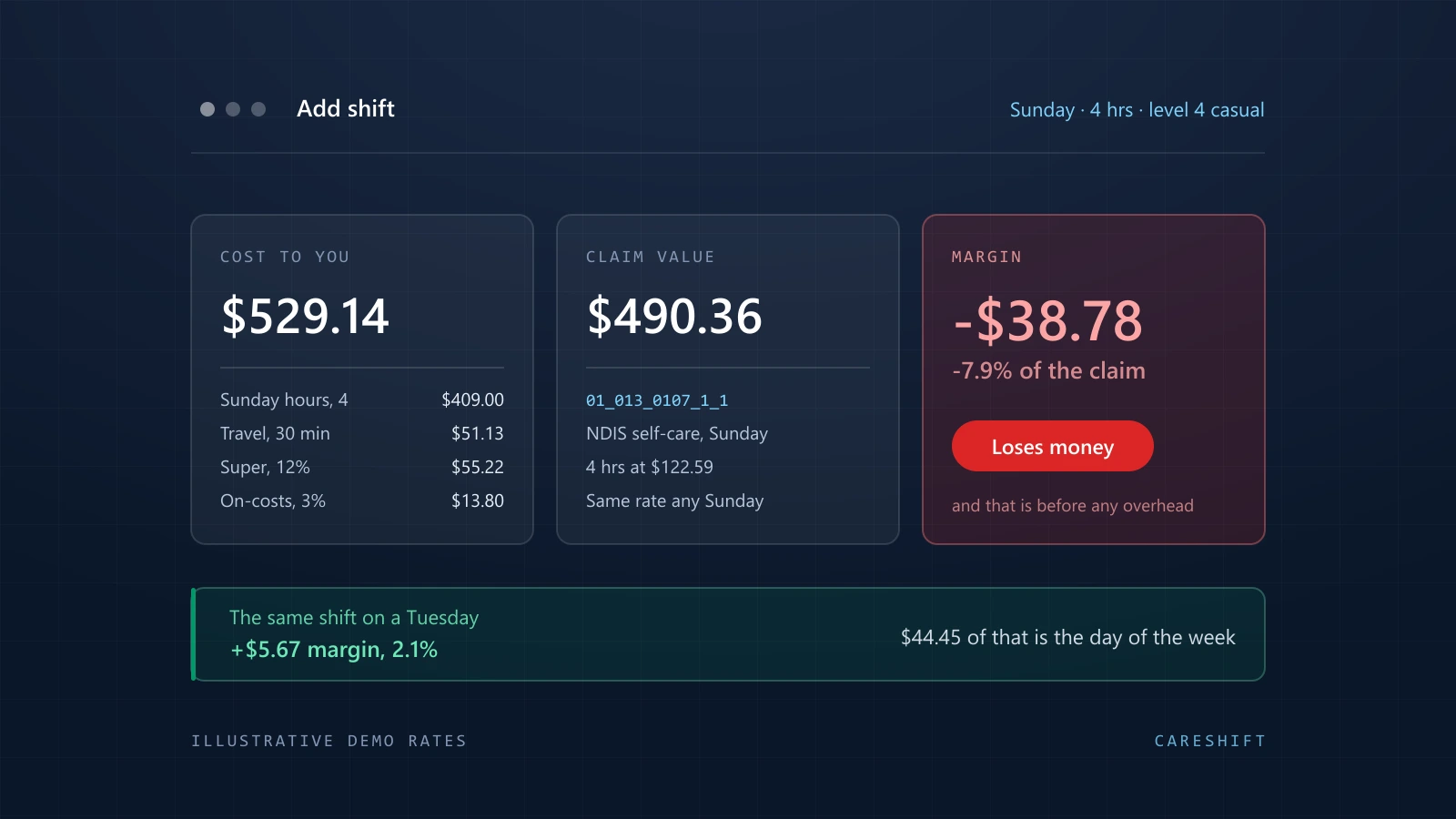
We built the front end first and nothing else. Eight screens covering the whole week, running on simulated data in the browser, with a cost engine shaped like the SCHADS award and a claim engine mapped to support items. The screen the concept lives or dies on is Add Shift: pick a worker, a client, a day and a time, and the true cost, the claim value and the margin appear together and recalculate as you change anything. Move a weekday shift to Sunday and the margin visibly collapses. That single interaction is the product hypothesis, and it can be tested with real operators before a line of backend is written.
Integration reality
Every integration this product would need has a known, documented path, and none of them are connected in this demo. Payroll would go to Xero through their published API and app partner process. Support at Home claiming would go through the Services Australia business to government developer portal. NDIS claiming works today with a bulk payment request file, which is what the demo generates. Direct NDIA API submission requires Digital Partnership Office approval that we have not applied for. We researched the paths before building the screens, so the demo never shows a flow that could not exist.
Who built it
Product concept, domain modelling, interaction design and the front-end build. In house at Incendio Solutions, not client work.
Technologies
FAQ
Related work
Multi-tenant SaaS with role-optimised views for dispatchers, managers and drivers
Dispatch, work orders and compliance for a mobile workforce
Replacing phone and fax ordering with a self-serve trade portal
Every working build you can open in a browser, no login
Next case study
6,500 Plants Under Continuous Autonomous Control
Send the constraint that worries you most - a latency budget, a power budget, a certification date. We’ll tell you straight whether we’re the right team.